Which Cattle Gate Goes Where: Slide, Bow, Tube and Value
Four gate types, four jobs. How to sort slide, bow, tube and value gates by pressure, width and the post that has to carry them.
A gate is the most-used piece of equipment on the place. It gets opened twice a day, banged by a tractor bucket, leaned on by a horse, and dragged through mud for twenty years. Yet most people buy one by walking the yard and picking the one that looks strongest. The right question is not which gate is strongest. It is which gate belongs where.
Most Texas lots carry four broad classes: slide gates, bow gates, tube gates and value gates. They overlap in size and they all hold cattle, but they solve different problems. Get the class right and the gate lasts. Get it wrong and you will be rebuilding a post in two years.
Slide gates: where a swing will not work
A slide gate hangs from a track or rollers and travels sideways instead of swinging. That one difference is the whole reason it exists. A swing gate needs a clear arc of ground, and it needs you to stand in that arc to open it. In an alleyway, a load-out lane, or a pen corner where two fences meet, there is no room for that arc.
Slide gates shine in tight, high-traffic spots: the end of an alley, a load-out chute, a gate across a lane where a truck has to pass. You pull or push it straight along the fence line and it stacks out of the way. Nothing swings into the cattle and nothing swings into you.
The trade-off is the track. A slide gate carries its weight on rollers and a top rail instead of on hinges, so both end posts have to be solid and in line. If one post settles, the gate racks and drags. Mud, ice and hay chaff in the track make it worse. Set the posts deep, keep the track clean, and a slide gate will outlast most swing gates in the same spot.
Bow gates: the working pen door
A bow gate has an arched top and is built to pin into a panel line. The arch is not decoration. It gives you height in the middle of the opening, which is where a pickup, a tractor with a loader, or a horse and rider actually needs it, without building a tall, heavy rectangular frame.
That makes the bow gate the natural door for a set of freestanding pens. It pins to the panels, swings or slides depending on the model, and keeps the pen line rigid. It is also the gate most people mean when they say they need a drive-through into a corral.
Check the latch and the hinge on a bow gate before you buy. A bowed gate that has been stacked wrong can be twisted, and a twisted gate never latches clean. Set it on flat ground and swing it through its arc in the yard if you can.
Tube gates: the pasture standard
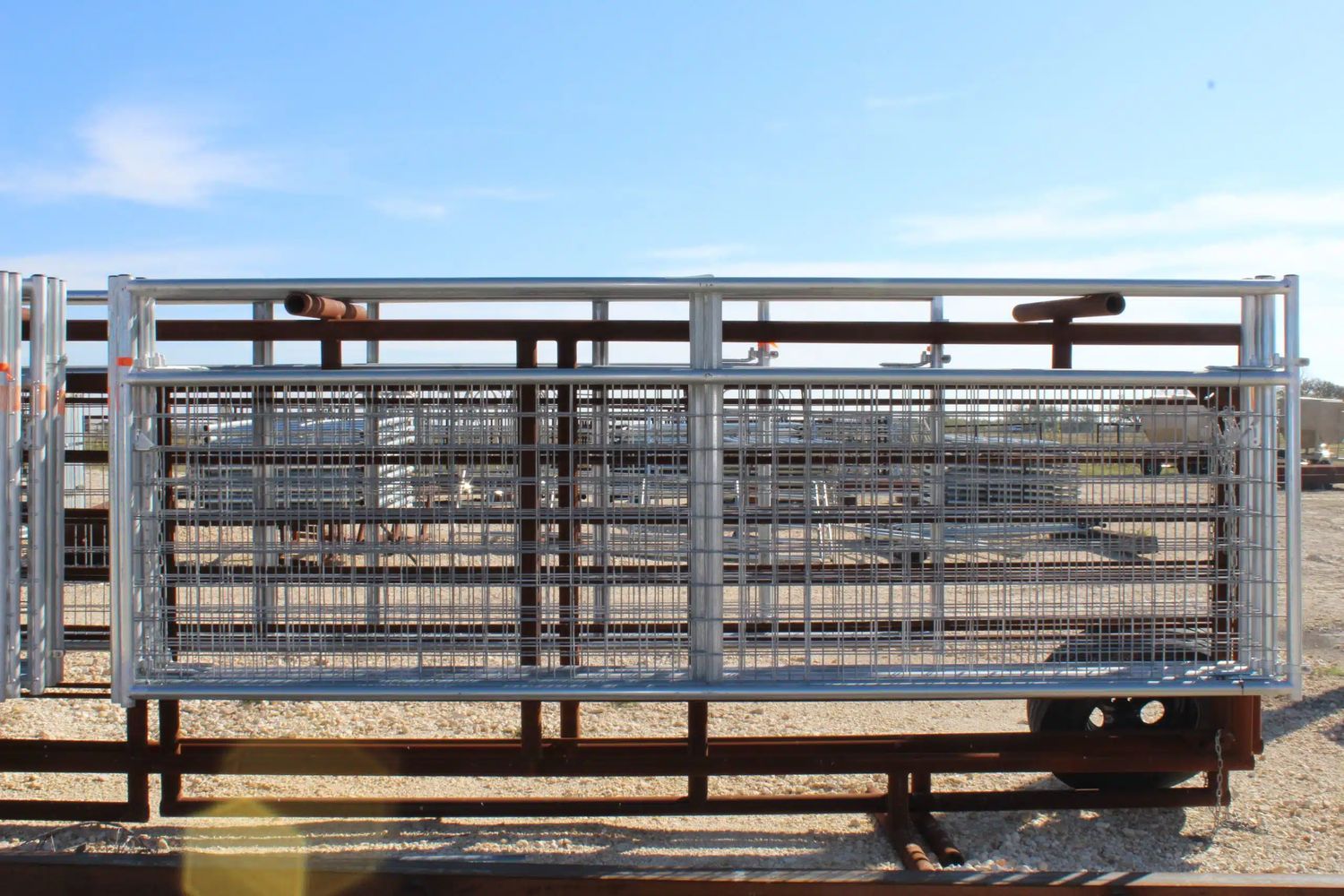
The welded tube gate, usually five or six horizontal bars, is the gate that hangs between two posts in a fence line. It is light enough for one person to swing, wide enough for a truck, and cheap enough to put one at every corner of a pasture. Twelve feet is the common width; fourteen and sixteen show up where equipment is bigger.
Tube gates are pasture gates, not pressure gates. They are built to keep cattle in and let people through, not to take a bull hitting them or a loader bucket pushing on them. Hang one in a bull pen and you will be straightening bars.
One detail people miss: bar spacing. A newborn calf can sometimes slip between the bars of a wide-spaced gate. If you calve in that pen, look at the spacing, not just the height.
Value gates: honest light duty
A value gate is exactly what the name says. Less steel, lighter tubing, a simpler build, a lower price. There is nothing wrong with that as long as it goes where it belongs: a hay yard, a lane between pastures, a temporary division, a gate that mostly gets walked through.
Put a value gate at the end of an alley where cattle are pushed hard, or in a pen where a tractor turns around, and it will show you the difference within a season. The bars bend, the frame racks, and the latch stops lining up. Buy the light gate for the light job and spend the money where the pressure is.
Match the gate to the pressure
Sort every gate location on your place into two piles: high pressure and low pressure.
- High pressure: alleys, load-out, sorting pens, bull pens, anything a tractor or trailer drives through, anything cattle are pushed into.
- Low pressure: pasture divisions, hay lots, lanes, gates that mostly see people and horses.
High pressure gets the heaviest gate and the best posts you can justify. Low pressure gets a tube or value gate and you put the savings into the fence line. Most gate failures are not the gate's fault. They are a light gate in a heavy spot, or a good gate on a bad post.
Width and height
Measure the widest thing that will ever pass through the opening, then add room. A pickup with mirrors is wider than people think, and a tractor with a loader bucket is wider still. Twelve feet handles most ranches. If a feed truck or a large tractor comes through, go to fourteen or sixteen.
Height matters less than width for cattle, but it matters for equipment and for horses. A five-foot gate is the common working height. Check the actual gate width against your post spacing before you dig. Gates are usually a few inches under their nominal size, and posts set exactly at nominal width can leave you short on clearance.
Hanging a gate so it lasts
The gate post carries everything. A gate hung on a T-post will sag, and it will keep sagging no matter how many times you adjust the hinges. Use a wood post of at least six inches, set three and a half to four feet deep, or a steel post of equivalent strength. The latch post needs to be just as solid as the hinge post, or the gate will latch in April and miss in August when the ground moves.
Brace the hinge post against the pull of the gate. An H-brace or a diagonal brace transfers the load into the ground instead of letting the post lean. This is the step people skip, and it is the reason gates drag.
Leave clearance under the gate. A gate that drags the ground will bend its own frame every time it is opened. Set it two to four inches off the ground on level ground, and plan for the low spot if the ground is not level.
Mistakes worth avoiding
- Hanging a gate on a line post instead of a braced gate post.
- Buying a light gate for an alley because it was in stock.
- Setting posts at the nominal gate width without checking the actual gate.
- Putting a slide gate on posts that are not in line, then blaming the rollers.
- Forgetting a walk-through gate in a pen that only has a drive-through.
Walk your place with a notepad before you buy anything. Mark every gate, note what passes through it and how hard cattle get pushed there, and write the width beside it. That list will tell you more about what to buy than any catalog will. Delivery is available, and the folks at either store will help you sort a gate list into pressure classes if you bring the measurements.
Common questions
What width cattle gate should I buy?
Twelve feet is the common working width and handles most pickups and small tractors. Go to fourteen or sixteen feet if a feed truck, a large tractor or a trailer has to pass. Measure the widest thing that will use the opening and add room, then check the gate's actual width against your post spacing before you dig.
Can I hang a gate on a T-post?
No. A T-post will lean under the weight of a gate and keep leaning no matter how often you adjust the hinges. Use a wood post of at least six inches set three and a half to four feet deep, or a steel post of equivalent strength, and brace it against the swing.
Where does a slide gate make more sense than a swing gate?
Anywhere there is no room for a swing arc: the end of an alley, a load-out lane, a pen corner, or a gate across a lane a truck uses. A slide gate travels along the fence line, so nothing swings into the cattle or into you. The trade-off is that both end posts have to be solid and in line.
What is the difference between a tube gate and a value gate?
Both are welded steel swing gates, but a value gate uses lighter tubing and less steel. A tube gate belongs in a pasture line; a value gate belongs in a hay yard or a lane. Put a value gate where cattle are pushed hard and it will bend within a season.